
الكلمات المفتاحية
المعرفة
القيم
المهارة
فلسفة التربية
التعاليم الإسلامية
كيفية الاقتباس




الملخص
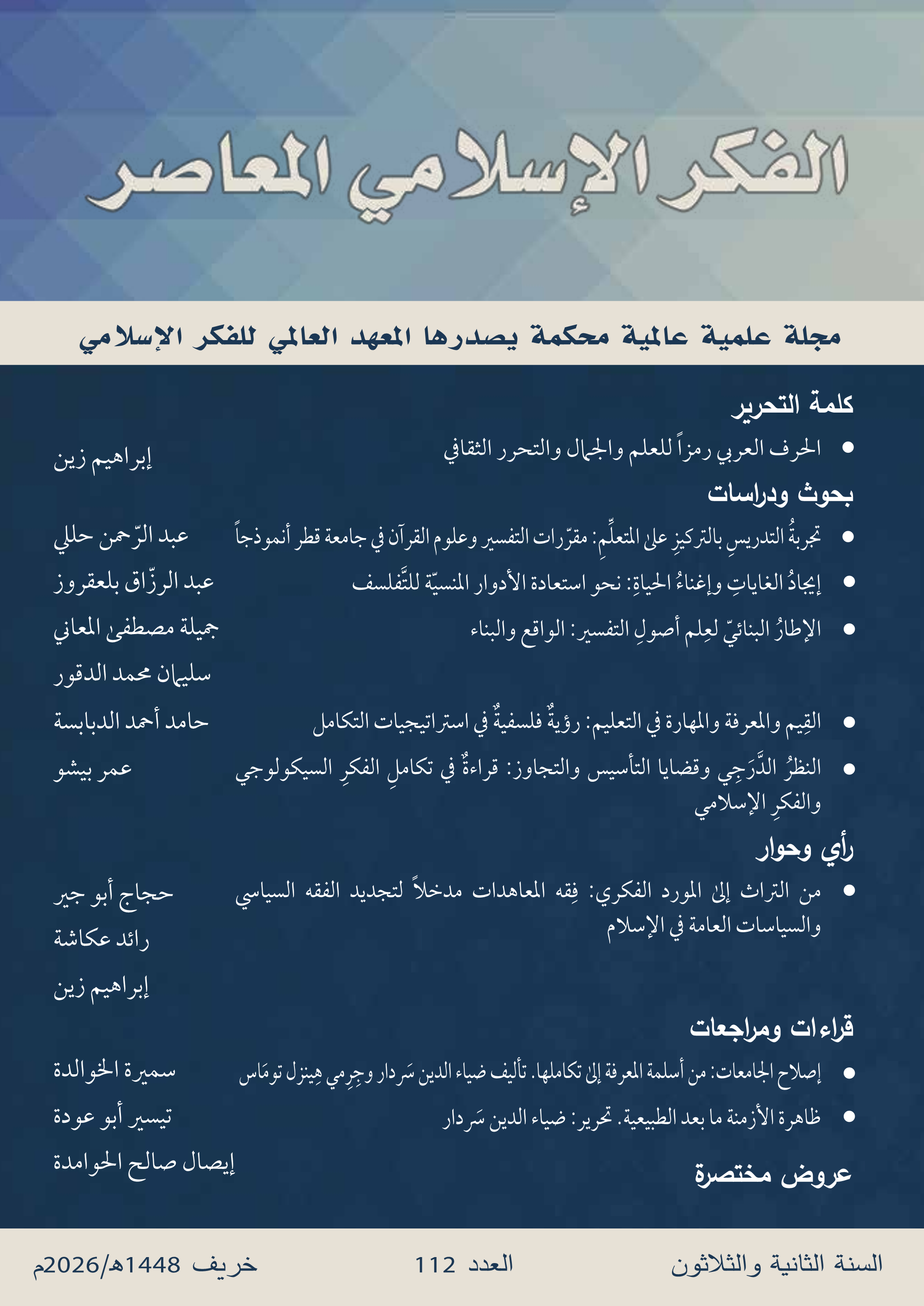
يعرض هذا البحثُ التطوُّرات الكبرى التي لحقت بالتعليم في عالمٍ مفتوحِ المصادر، ويُبيِّن أهمية التكامل بين المعرفة والقيم والمهارة، ودور المشاركين فيها، كالأُسْرة والمدرسة والمجتمع والمنهج، وضرورة وضع استراتيجية واضحة تربط بين هذه الـمُكوِّنات نظرياً وعملياً؛ لتصبح العملية التعليمية ناجحة ومثمرة وقابلة للتطبيق، وقادرةً على الاستجابة للتحديات الناشئة؛ لتُقدِّم تعليماً يجعل الـمُتعلِّم أهلاً لمواجهة التحديات والتطوُّرات الناشبة، من أجل إعداده بخصائص وكيفيات تتناسب مع الواقع العالمي الـمُتغيِّر بقوَّة في مختلف الجوانب: المعرفية والأخلاقية والمهارية والسلوكية. كذلك يعرض البحثُ أبرزَ ما قدَّمته الفلسفات التربويّة العالميّة الجديدة؛ للاستفادة من استراتيجيات هذه الفلسفات وتوظيفها بنجاح، في الوقت الذي ينبغي فيه التوفيق بينها وبين الأصالة المعرفية والقيمية الـمُتكامِلة في التعاليم الإسلامية نظرياً وعملياً.
المراجع
ديكارت، رينيه (2009). التأملات في الفلسفة الأولى، ترجمة وتقديم وتعليق: عثمان أمين، القاهرة: المركز القومي للترجمة.
شنيور، عامر محمود (2022). المنهج الفينومينولوجي في دراسة الدين وتطبيقاته عند إسماعيل الفاروقي، فرجينيا: المعهد العالمي للفكر الإسلامي.
العوا، عادل (1986). العمدة في فلسفة القيم، دمشق: دار طلاس للدراسات والترجمة والنشر.
أبو الفضل، منى محمد عبد المنعم (2024). الرؤية الإسلامية للإنسان، الفاعلية والعقلانية والأخلاقية في القرآن الكريم، ترجمة: السيد محمد السيد عمر، ط1، فرجينيا: المعهد العالمي للفكر الإسلامي.
ملكاوي، فتحي (2008). "التأصيل الإسلامي لمفهوم القيم"، المعهد العالمي للفكر الإسلامي، مجلة الفكر الإسلامي المعاصر (إسلامية المعرفة سابقاً)، 14(54).
هيئة التحرير (2019). "تربية القيم في عصر ما بعد الحقيقة"، المعهد العالمي للفكر الإسلامي، مجلة الفكر الإسلامي المعاصر (إسلامية المعرفة سابقاً)، 24(96).
اليونسكو (2015). "إعادة التفكير في التربية والتعليم: نحو صالحٍ مشتركٍ عالميّ"، منشورات اليونسكو: https://unesdoc.unesco.org/ark:/48223/pf0000232555_ara
References
Abū al-Faḍl, M. M. ʿA. al-M. (2024). Al-ruʾyah al-Islāmiyyah li-l-insān: Al-fāʿiliyyah wa-al-ʿaqlāniyyah wa-al-akhlāqiyyah fī al-Qurʾān al-karīm (al-S. M. al-S. ʿUmar, Translator; 1st ed.). al-Maʿhad al-ʿĀlamī li-l-Fikr al-Islāmī.
al-ʿAwwā, ʿA. (1986). Al-ʿumdah fī falsafat al-qiyam. Dār Ṭalās li-l-Dirāsāt wa-al-Tarjamah wa-al-Nashr.
Bereiter, C. (2002). Education and mind in the knowledge age. Lawrence Erlbaum Associates Publishers.
Bransford, J. D., Brown, A. L., & Cocking, R. R. (2000). How people learn: Brain, mind, experience, and school. National Academy Press.
Cambridge Assessment. (2017). The Cambridge approach to assessment: Its principles and their design. University of Cambridge.
Castells, M. (2010). The rise of the network society (2nd ed., Vol. 1). Wiley-Blackwell.
Darling-Hammond, L., Burns, D., Campbell, C., Goodwin, A. L., Hammerness, K., Low, E. L., & Zeichner, K. (2017). Empowered educators: How high-performing systems shape teaching quality around the world. John Wiley & Sons.
Descartes, R. (2006). A discourse on the method of correctly conducting one's reason and seeking truth in the sciences (I. Maclean, Translator). Oxford University Press.
Descartes, R. (2009). Al-taʾammulāt fī al-falsafah al-ūlā (ʿU. Amīn, Translator). al-Markaz al-Qawmī li-l-Tarjamah.
Dreyfus, H. L., & Dreyfus, S. E. (2005). Peripheral vision: Expertise in real-world contexts. Organization Studies, 26(5), 779–792.
Freire, P. (2000). Pedagogy of the heart. Continuum.
Fullan, M. (2012). Change forces: Probing the depth of educational reform. Routledge.
Hattie, J. (2012). Visible learning for teachers: Maximizing impact on learning. Routledge.
Hayʼat al-Taḥrīr (2019). tarbiyat al-Qayyim fī ʻaṣr mā baʻda al-ḥaqīqah, al-Maʻhad al-ʻĀlamī lil-Fikr al-Islāmī, Majallat al-Fikr al-Islāmī al-muʻāṣir (Islāmīyah al-Maʻrifah sābiqan), 24 (96).
Jackson, P. W. (1968). Life in classrooms. Holt, Rinehart & Winston.
Kahne, J., & Bowyer, B. (2017). Educating for democracy in a partisan age: Confronting the challenges of motivated reasoning and misinformation. American Educational Research Journal, 54(1), 3–34.
Kant, I. (1906). Kant on education (A. Churton, Translator). D. C. Heath & Co.
Kohlberg, L. (1981, 1984). The psychology of moral development: The nature and validity of moral stages (Vols. 1–2). Harper & Row.
Kolb, D. A. (2015). Experiential learning: Experience as the source of learning and development (2nd ed.). Pearson Education.
Lickona, T. (2006). Eleven principles of effective character education. The Journal of Moral Education, 25(1), 93–100.
Locke, J. (1927). Some thoughts concerning education. Cambridge University Press.
Malkāwī, F. (2008). al-taʼṣīl al-Islāmī li-mafhūm al-Qayyim, al-Maʻhad al-ʻĀlamī lil-Fikr al-Islāmī, Majallat al-Fikr al-Islāmī al-muʻāṣir (Islāmīyah al-Maʻrifah sābiqan), 14 (54).
Meier, J. D. (n.d.). What is strategy? A fresh perspective.
National Center on Education and the Economy. (2015). What it means to be career ready: Our analysis of the skills that matter.
Nucci, L. (2009). Nice is not enough: Facilitating moral development. Pearson Education.
Nucci, L. P. (2001). Education in the moral domain. Cambridge University Press.
OECD. (2019). OECD learning compass 2030. OECD Publishing.
Perkins, D. (1992). Smart schools: Better thinking and learning for every child. Free Press.
Piaget, J. (1970). Science of education and the psychology of the child. Orion Press.
Sennett, R. (2008). The craftsman. Yale University Press.
Shunayyūr, ʿA. (2022). Al-manhaj al-fīnūminūlūjī fī dirāsat al-dīn wa-taṭbīqātuhu ʿinda Ismāʿīl al-Fārūqī. International Institute of Islamic Thought.
The Strategy Institute. (2023). What is business strategy? Definition, importance, levels, and examples.
UNESCO. (2015a). Iʿādat al-tafkīr fī al-tarbiyah wa-al-taʿlīm: Naḥwa ṣāliḥ mushترك ʿālamī. UNESCO Publishing.
UNESCO. (2015b). Rethinking education: Towards a global common good. UNESCO Publishing.
Vygotsky, L. S. (1978). Mind in society: The development of higher psychological processes. Harvard University Press.
World Economic Forum. (2015). New vision for education: Unlocking the potential of technology.
World Economic Forum. (2020). The future of jobs report 2020.

هذا العمل مرخص بموجب Creative Commons Attribution-NonCommercial-NoDerivatives 4.0 International License.
الحقوق الفكرية (c) 2026 المعهد العالمي للفكر الإسلامي