
الكلمات المفتاحية
الحداثة
نـزع الآدمية
مقاربة سوسيولوجية دولية
الخطاب القيمي
كيفية الاقتباس




الملخص
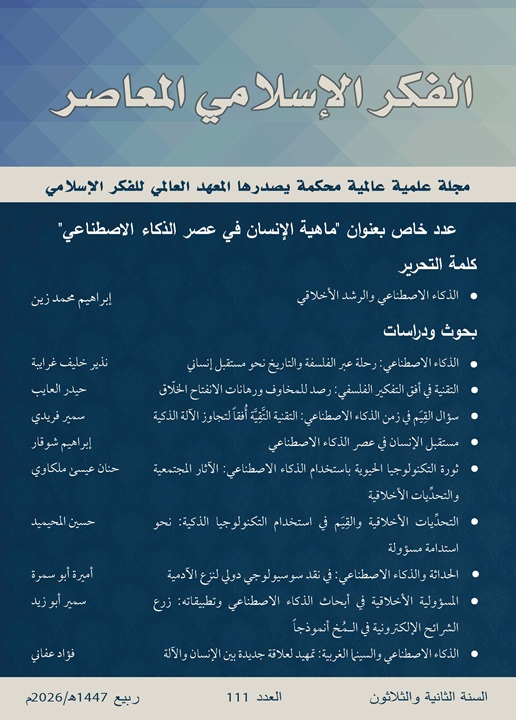
يُطِلُّ الذكاء الاصطناعي علينا اليوم بوصفه لحظة انتقالية فارقة في مسار البشرية تحمل نقلة نوعية غير مسبوقة من حيث نطاق التأثير وامتداداته في المجالات الاجتماعية والسياسية والاقتصادية. يعتمد البحث مقاربة سوسيولوجية دولية نقدية لتُقدِّم تحليلاً كيفياً للعلاقة الجدلية بين الحداثة والذكاء الاصطناعي ونـزع الآدمية. ويطرح البحث تساؤلاً محورياً: هل يُعَدُّ الذكاء الاصطناعي امتداداً للمنطق الحداثي بأدوات رقمية جديدة تُرسِّخ التفاوتات الدولية، وتُعمِّق أنماط السيطرة، أم أنَّه تحدٍ جذري لهذا المنطق بما يحمله من تهديد لآدمية الإنسان نفسه، وتقويضٍ لادعاءات الفاعل الحداثي القدرةَ على التحكُّم الكامل في العالَم من حوله؟
وتشير النتائج إلى أن الذكاء الاصطناعي -رغم ظهوره استمراراً لمشروع العقل الحداثي- يكشف هشاشة هذا المشروع؛ إذ لم يعد نـزع الآدمية يقتصر على "الآخر" المستضعَف، بل طال حتى "الذات" التي عدّت نفسها معياراً للإنسانية، مما يبرز مفارقات جوهرية في منطق المشروع الحداثي. وبناء عليه، فإن البحث يدعو إلى ضرورة إعادة بناء خطاب قِيَمي عالمي يعيد الاعتبار إلى الإنسان بوصفه فاعلاً اجتماعياً أخلاقياً مسؤولاً.
المراجع
باومان، زيجمونت (2014). الحداثة والهولوكوست. ترجمة: حجاج أبو جبر ودينا رمضان. القاهرة: دار مدارات للأبحاث والنشر.
الخطيب، معتز عبد اللطيف (2007). الوظيفة المقاصدية: مشروعيتها وغايتها، مجلة إسلامية المعرفة (الفكر الإسلامي المعاصر لاحقاً)، السنة12، العدد48، 11-35.
أبو سمرة، أميرة (2023). المنظور النقدى للعدالة الخوارزمية بين التحيز والرقابة، السياسة الدولية: رؤى استشرافية.
عبد الفتاح، سيف (2022). "المدخل القيمي: إطار لدراسة العلاقات الدولية في الإسلام،" في موسوعة العلاقات الدولية في الإسلام، تحرير نادية مصطفي، القاهرة: مركز الحضارة للدراسات والبحوث ودار السلام.
المسيري، عبد الوهاب (1996). فقه التحيز، في: إشكالية التحيز: رؤية معرفية ودعوة للاجتهاد. هرندن-فرجينيا: المعهد العالمي للفكر الإسلامي.
References
Abd El-Fattah, S. (2022). Al-Madkhal al-Qiyamī: Iṭār li-Dirāsat al-ʿAlāqāt al-Dawliyya fī al-Islām [The normative approach: A framework for the study of international relations in Islam]. In N. Mostafa (Ed.), The Encyclopedia of International Relations in Islam (2nd ed.). Cairo: Markaz al-Ḥaḍāra lil-Dirāsāt wa-al-Buḥūth & Dār al-Salām.
American Red Cross. (2011). Summary of the Geneva Conventions of 1949 and their Additional Protocols. Retrieved from: https://www.redcross.org/content/dam/redcross/atg/PDF_s/International_Services/International_Humanitarian_Law/IHL_SummaryGenevaConv.pdf
Abou Samra, A. (2023). A Critical Perspective on Algorithmic Justice (Ruʾyah Naqdiyyah ʿan al-ʿAdālah al-Khawārizmiyyah). Theoretical Strands: International Politics.
Alkhateeb, M. (2007). The Maqasidi Task: Its Legitimacy and Purpose, Alwatheefah Almaqasedeyah: Mashrou'eyatha wa ghayatha. islamization of Knowledge, 11-35.
Al-Messiri, A. (1996). Understanding Bias (Fiqh al-Taḥayyuz). In A. Al-Messiri, The Problem of Bias: An Epistemological Perspective and an Invitation to Reasoning (Ishkāliyyat al-Taḥayyuz: Ruʾyah Maʿrifiyyah wa-Daʿwah lil-Ijtihād) (pp. 3–108). Herndon, VA: International Institute of Islamic Thought.
Arendt, H. (1951). The Origins of Totalitarianism. New York: Harcourt.
Ayana G. (2024). Decolonizing Global AI Governance: Assessment of the State of Decolonized AI Governance in Sub-Saharan Africa. Royal Society Open Science, 1-16.
Bauman, Z. (2014). Al-Ḥadāthah wa-al-Holocaust [Modernity and the Holocaust]. Ḥajjaj Abū Jabr and Dina Ramadan (trans.). Cairo: Madārāt lil-Abhāth wa-al-Nashr.
Bender, E. (2024). Resisting Dehumanization in the Age of “AI”. Current Directions in Psychological Science.
Coleman, D. (2019). Digital Colonialism: The 21st Century Scramble for Africa through the Extraction and Control of User Data and the Limitations of Data.
Crawford, K. (2021). Atlas of AI. New Haven and London: Yale University Press.
Fanon, F. (2008). Black Skin, White Masks. New York: Grove Press.
Griffiths, M. (2019). The Great Firewall of China. Zed Books.
Grosfoguel, R. (2010). Epistemic Islamophobia and Colonial Social Sciences. Human Architecture: Journal of the Sociology of Self-Knowledge, 8(2), 29-38.
Guest, L. V. (n.d.). Artificial Intelligence: Panacea or Non-Intentional Dehumanization? Journal of Human Technology Relations, 1-11.
Harding, U. N. (2002). Decentering the Center: Philosophy for a Multicultural, Postcolonial and Feminist World. Indiana University Press.
J. Corey Williams, N. A. (2020). Colorblind Algorithms: Racism in the Era of COVID-19. Journal of the National Medical Association, 550-552.
Janna Anderson, L. R. (2018). Artificial Intelligence and the Future of Humans. Pew Research Center.
Khoury-Machool, M. (2010). Cyber Resistance: Palestinian Youth and Emerging Internet Culture. In A. B. Herrera, Being Young and Muslim: New Cultural Politics in the Global South and Global North. Oxford: Oxford Scholarship Online.
Kronfeldner, M. (2021). Editor's Preface. In M. Kronfelder (Ed.), Routledge Handbook of Dehumanization (pp. 1-34). Routledge.
Kulkarni, S. S. (2024). Artificial Intelligence and its Uses in Modern Days. International Journal of Artificial Intelligence Research and Development, 48.
Laura Robinson, J. S. (2020). Digital Inequalities 3.0: Emergent Inequalities in the Information Age. First Monday: Peer-Reviewed Journal on the Internet.
Lee, E. (2022). Are We Losing Control. In E. Lee & H. Werthner (Eds.), Perspectives on Digital Humanism (p. 3). Springer.
Lyon, D. & Zygmunt B. (2013). Liquid Surveillance: A Conversation. Polity Press.
Malkawi, F. (2008). An Islamic Foundational Definition of Values (Al-Taʾsīl al-Islāmī li-Mafhūm al-Qiyām). Contemporary Islamic Thought, 6, 6–10.
Manjikian, M. M. (2010). From Global Village to Virtual Battlespace: The Colonizing of the Internet and the Extension of Realpolitik. International Studies Quarterly, 381-401.
Marzsalek-Kotzur, I. (2020). Cognitive Technologies - Are We in Danger of Humanizing Machines and Dehumanizing Humans? Management Systems in Production Engineering, 28, 269-275.
Nazzal, A. (2020, December). YouTube’s Violation of Palestinian Digital Rights: What Needs to be Done? The Palestinian Policy Network. https://al-shabaka.org/wp-content/uploads/2020/12/Nazzal_PolicyBrief_Eng_Dec2020.pdf
Netanyahu's Speech at AIPAC. (2018, March 06). YouTube. https://www.youtube.com/watch?v=77GdJHRQC4Q
Noble, S. U. (2018). Algorithms of Oppression: How Search Engines Reinforce Racism. New York: New York University Press.
Patrick Maillé, G. M. (2021). Are Search Engines Biased? Detecting and Reducing Bias using Meta Search Engines. Hal Archives-Ouvertes.
Quetteville, H. D. (2022, February 04). The Telegraph. https://www.telegraph.co.uk/news/2022/02/04/mind-control-elon-musks-next-move-looking-human-volunteers/
Sinkovec, G. J. (2021). Involvement of Artificial Intelligence in Modern Society. International Journal of Management, Knowledge and Learning.

هذا العمل مرخص بموجب Creative Commons Attribution-NonCommercial-NoDerivatives 4.0 International License.
الحقوق الفكرية (c) 2026 المعهد العالمي للفكر الإسلامي