
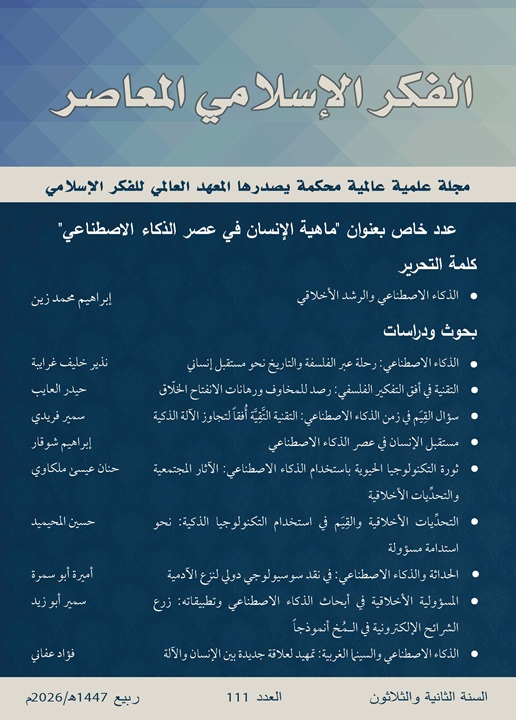
Keywords
chip implanting in the brain
cultural diversity
Arab-Islamic worldview
ethics
How to Cite




Abstract
This article presents a brief review of the need to regulate research and applications of “Artificial Intelligence” (AI) within the concept of “Responsible AI,” with a focus on the ethical dimension. The literature indicates that the field of AI is still developing, and there are diverse views on efforts to regulate it. The article focuses in particular on issues related to implanting electronic chips in the brain and creating brain-computer interfaces (BCIs), especially the problem of the fusion of responsibility between humans and machines. It then discusses this issue from an Arab-Islamic worldview perspective and deduces the ethical conditions for such applications that ensure the person’s responsibility for his actions. These conditions are that activities be limited to necessary cases; that the inner workings of the implant be fully transparent; that the implant perform exactly as the user intends; and that the user become fully responsible for the actions that result from his use of the implant.
References
أبو زيد، سمير (2008). العلم وشروط النهضة: التصورات العلمية الجديدة والتأسيس العلمي للنهضة، القاهرة: مكتبة مدبولي.
أبو زيد، سمير (2009). العلم والنظرة العربية إلى العالم: التجربة العربية والتأسيس العلمي للنهضة، بيروت: مركز دراسات الوحدة العربية.
ابن عاشور، محمد الطاهر (2001). مقاصد الشريعة الإسلامية، تحقيق ودراسة: محمد الطاهر الميساوي، عمّان: دار النفائس.
References
abn ʿāshūr, mḥmd ṭ-ṭāhr (2001). mqāṣd sh-shrīʿt l-islāmīt, tḥqīq ūdrāst: mḥmd ṭ-ṭāhr l-mīsāwy, ʿmwān-āl'ardn: dār n-nfā'is.
'abū zīd, smīr (2008). l-ʿlm ūshrūṭ n-nhḍt: t-tṣūrāt l-ʿlmīt l-jdīdt wālt'asīs l-ʿlmī llnhḍt, mṣr - l-qāhrt: mktbt mdbūlī.
abū zīd, smīr (2009). l-ʿlm wālnẓrt l-ʿrbīt il l-ʿālm: t-tjrbt l-ʿrbīt wālt'asīs l-ʿlmī llnhḍt, lbnān- bīrūt: mrkz drāsāt l-ūḥdt l-ʿrbīt.
Bjerring, J. C., & Busch, J. (2024.). Artificial intelligence and identity: the rise of the statistical individual. AI & SOCIETY. doi:https://doi.org/10.1007/s00146-024-01877-4
Brumen, B., Gollner, S., & Tropmann-Frick, M. (2023). Aspects and Views on Responsible Artificial Intelligence. In G. Nicosia, V. Ojha, E. La Malfa, G. La Malfa, P. Pardalos, G. Di Fatta, . . . R. Umeton (Ed.), Machine Learning, Optimization,and Data Science LOD 2022. 8, pp. 384–398. Certosa di Pontignano, Italy: Springer.
Burgard, W. (2022). Artificial Intelligence - Key Technologies and Opportunities. In S. Voeneky, P. Kellmeyer, O. Mueller, & W. Burgard, The Cambridge Handbook of Responsible Artificial Intelligence- Interdisciplinary Perspective (pp. 11-30). Cambridge: Cambridge University Press.
Chesterman, S. (2021). We , The Robots ? Regulating Artificial Intelligence and the Limits of the Law. Cambridge: Cambridge University Press.
Essmann, B., & Mueller, O. (2022). AI-Supported Brain–Computer Interfaces and the Emergence of ‘Cyberbilities'. In S. Voeneky, P. Kellmeyer, O. Mueller, & W. Burgard (Eds.), “The Cambridge Handbook of Responsible Artificial Intelligence - interdisciplinary perspectives (pp. 427-443). Cambridge: Cambridge University Press.
Friedenberg, J. (2020). The Future of the Self - An Interdisciplinary Approach to Personhood and Identity in the Digital Age . California: University of California Press.
Garibay, O., Winslow, B., Andolina, S., Antona, M., Bodenschatz, A., Coursaris, C., . . . Jirot, M. (2023). Six Human-Centered Artificial Intelligence Grand Challenges. International Journal of Human–Computer Interaction, 39 (3), 391-437.
Hellström, T., & Bensch., S. (2024). Apocalypse now: no need for artificial general intelligence. AI & SOCIETY, 39, 811–813. doi:https://doi.org/10.1007/s00146-022-01526-8
Livingston, S., & Risse., M. (2019). The Future Impact of Artificial Intelligence on Humans and Human Rights. Ethics & International Affairs, 33(2), 141–158.
Mehta, D. (2024, April 17). Why Elon Musk's Neuralink brain implant reframes our ideas of self-identity. Retrieved 2024, from BBC.
Tallinn, J., & Ngo, R. (2022). Automating Supervision of AI Delegates. In S. Voeneky, P. Kellmeyer, O. Mueller, & W. Burgard (Eds.), The Cambridge Handbook of Responsible Artificial Intelligence - interdisciplinary perspectives (pp. 19-30). Cambridge: Cambridge University Press.
Voeneky, S., Kellmeyer, P., Mueller, O., & Burgard, W. (2022). Introduction. In S. Voeneky, P. Kellmeyer, O. Mueller, & W. Burgard (Eds.), The Cambridge Handbook of Responsible Artificial Intelligence - interdisciplinary perspectives (pp. 1-8). Cambridge: Cambridge University Press.

This work is licensed under a Creative Commons Attribution-NonCommercial-NoDerivatives 4.0 International License.
Copyright (c) 2026 المعهد العالمي للفكر الإسلامي